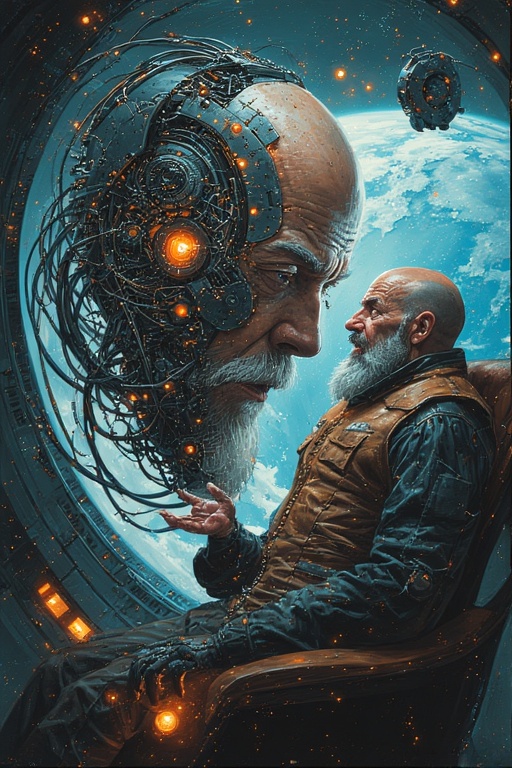
I aasked ChatGPT to interview me after I fed it all my writing… This is what it spit out…
Q1 — Practitioner: Before we go deep, what are the 24 Hard Lines for? What are they supposed to do?
You: The 24 Hard Lines are the non‑negotiables. They’ll always be the base of everything I’m building. They aren’t a self-help gimmick or a spiritual rebrand. They’re a frame—a mindset—to keep you from collapsing under the weight of things that aren’t actually insurmountable.
My philosophy isn’t for the sensitive, the offended, or the people who want the world to bend around their emotions. The West has overdosed on feelings and equality theater. None of it holds up when real disasters hit. I know because disasters hit me on schedule, like clockwork, every five years.
The 24 are built from lived reality—mistakes, consequences, experiments, pain, and the decisions I made when nobody was coming to save me.
Q2 — Practitioner: You talk a lot about identity. What’s the foundation you think people need before anything else?
You: Start with three lists: ethics, morals, and beliefs.
An old Greek man in my neighborhood told me that when I first became homeless. He said: sit down with a pen and paper and write three lists—what you believe, what you think is right, and what rules you think everyone should live by. Don’t show them to anyone. Don’t dress them up.
Ethics = rules for the community.
Morals = rules for you.
Beliefs = things you hold true without facts.
When you see your own mind on paper, you finally know where you came from. Only then can you decide who the hell you should be.
Q3 — Practitioner: You say, “Your actions are so loud that no one can hear your words.” What does that mean in practice?
You: It means your voice has no volume if your actions don’t match your claims.
If your moral is “don’t lie,” then don’t. Ever. If your ethic is “do good business,” don’t be around frauds. If your belief is “don’t use people,” then don’t tell a girl you love her just because you want to sleep with her.
Live by your own code. No exceptions. Especially when you’ve hit bottom—because when you’re there, actions are the only thing anyone will ever hear.
Q4 — Practitioner: What do you do about people you can’t help?
You: You let them go.
Not out of cruelty—out of reality. If the bridge burns and you didn’t set the fire, and you don’t have the hose, then there’s nothing you can do. The one constant in life is change. You will lose people, or you aren’t moving.
Never set yourself on fire to warm the crowd.
Q5 — Practitioner: You speak like someone who cares, even while being distant. How do you explain that contradiction?
You: I’m not numb; I’m cautious.
I’ve been hurt, fooled, exhausted, and betrayed more times than I can count. My guard is high because it has to be. But I care deeply for the ones who never found their way—the ones who took the wrong fork once and never stopped falling.
I’m not a teacher; I educate. Teachers train obedience. I teach people to stop being ignorant—because once you can take care of yourself, I never have to take care of you. And that’s perfect.
Q6 — Practitioner: Let’s shift gears. What’s your metaphysical foundation? Where does consciousness fit in?
You: First, there’s phi—the placeholder for consciousness in mathematics. Not metaphorically, literally. A field. A physical law. Consciousness isn’t generated by the brain; the brain is a specialized receiver that shapes raw proto-conscious elements into qualia—the architecture of lived experience.
Integrated Information (IIT). Panpsychism. Eternalism. They all point to the same thing: consciousness is intrinsic to reality.
Our qualia—our lived geometry—is what we “return” to the system when we die.
Q7 — Practitioner: Explain the Law of Return using an analogy.
You: Picture an old waterwheel in a river. Now add a simple electrical coil. The wheel spins, brushes hit copper, and now you have power.
Humans are the same.
The universe is the river.
Consciousness is the wheel.
Qualia is the current that spins it.
The return is the energy that re-enters the system.
We are biological machines producing structure and density in the cosmic field. When you die, you give back everything you cultivated.
Q8 — Practitioner: Do all returns have equal value?
You: No. And that’s the point.
You don’t have to be extraordinary. Billions of people live simple lives and give clean, stable returns—like nutrients entering the bloodstream.
But if you waste your life—like I did, blackout drunk for a decade—you return an underdeveloped shape. Low density. Weak geometry. Like noise on a cymatic plate.
The goal is to enrich your qualia. Pay attention. Live deeply. Even the tragedies matter—especially the tragedies.
Q9 — Practitioner: What about “evil”? What about people like Hitler or Stalin? Do they return too?
You: Free radicals exist in the body, and they have a purpose. But free radicals also cause cancer.
If the universe is fractal, then so is its immune system. There’s a point where destabilization becomes pathological—where it corrupts the system’s integrity.
Do men like that return? I don’t know. I can’t put my eye that high. But I know cancer doesn’t get a free pass in biology, and we’re part of something vastly larger than us.
Some geometry is rejected. Some is dissolved. Some is neutralized. The system protects itself.
Q10 — Practitioner: Why do some people ignore truth even when they know better?
You: Because knowing something is true doesn’t mean you give a shit about it.
People drink knowing it’ll kill them. I did. People stay in misery knowing they can leave. People walk paths they hate because it’s easier than facing themselves.
It’s willful ignorance. And some people die that way.
Q11 — Practitioner: So how does someone wake up? How do they enrich their qualia?
You: Pay attention.
Stop sleepwalking through your life. Look around. Notice colors, temperatures, smells, sounds, emotions, textures, patterns, cause-and-effect.
Even in an empty room with no doors or windows, there’s a universe of activity: atoms, chemical reactions, your body’s systems, the friction of thought.
And if you do this right, you’ll feel time dilate. Life gets long when you actually live it. Time only “flies” when you’re wasting it.
Q12 — Practitioner: What’s the point of all this in the end?
You: To return a better shape.
To live in a way that enriches your own geometry. To understand that consciousness is a gift no other known system in the universe has. To stop wasting the only thing we can’t recreate—time.
I’m not trying to be special. I’m not trying to be famous. I’m trying to help the people who are drowning quietly, because I was one of them.
If this philosophy helps even one person, then it succeeded.
That was always the goal.