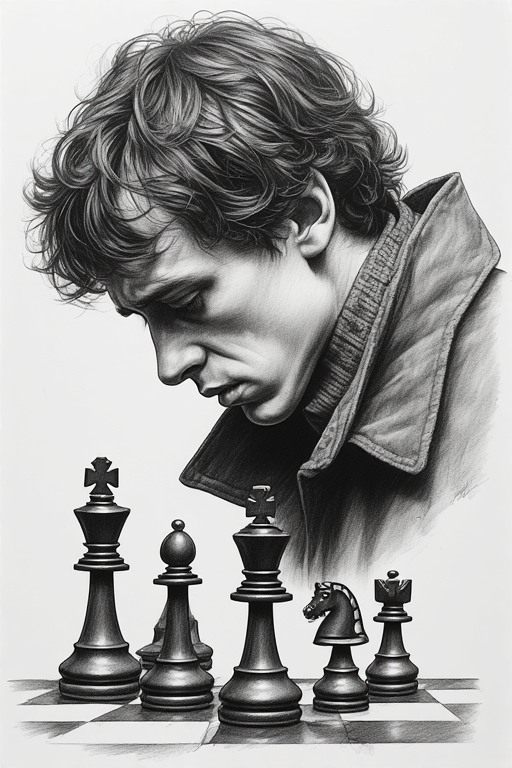
People praise deductive reasoning like it’s a superpower. Seeing patterns early. Connecting dots before others even notice they exist. Running scenarios ten moves ahead while the room is still arguing about move one. And it is a strength. But no one talks honestly about the cost.
So I will.
When you live in deduction, you rarely get to live in the moment. Your mind is already downstream, watching consequences unfold before they happen. You don’t just hear what someone says—you hear where it leads. You don’t just see a decision—you see the second, third, and tenth-order fallout. That changes how you experience the world.
It makes patience thin.
You end up frustrated with conversations that feel obvious, repetitive, or avoidable. People argue emotionally about outcomes you already know are baked in. You watch them walk toward walls you can already see, and when you try to warn them, it sounds abstract or arrogant. So you learn to shut up. Or worse, you learn to disengage.
Hard truth: seeing ahead isolates you.
Deductive thinking strips away comforting illusions. Hope based on vibes doesn’t survive contact with pattern recognition. You stop being surprised by outcomes, but you also stop being pleasantly surprised very often. When things go wrong, you’re not shocked—you’re tired. You already mourned it in advance.
There’s also a relational cost no one warns you about. When you see ten steps ahead, people assume you’re emotionally distant or pessimistic. They don’t realize you’ve already felt the loss they’re just beginning to imagine. They think you’re cold when you’re actually early.
That gap is lonely.
Deduction also creates a burden of restraint. When you know how things tend to end, you become careful about what you start. You hesitate where others leap. You look like you lack faith when in reality you have too much memory. You’ve seen how similar paths terminate, and you don’t confuse optimism with ignorance anymore.
Hard Line: foresight makes enthusiasm expensive.
There’s a quieter downside too—self-erasure. When you’re always scanning ahead, you don’t fully inhabit now. Joy becomes provisional. Calm feels temporary. You’re constantly adjusting for what’s coming instead of resting in what is. That’s not wisdom; that’s a nervous system stuck on watch duty.
Seeing ten steps ahead can turn into a prison if you’re not careful.
You start to believe responsibility means prevention. That if you don’t intervene, predict, or prepare, you’ve failed. You forget that some lessons can’t be preempted. Some people need to walk the whole path themselves. Some outcomes are only clear after they happen, no matter how sharp you are.
Hard Line: foresight does not grant authority over reality.
And here’s the hardest part to admit—deductive reasoning can make you miss miracles. Not because they don’t happen, but because they don’t fit the pattern. When you expect collapse, you don’t always recognize resilience. When you expect repetition, you can overlook rupture—the rare moment where something genuinely breaks the cycle.
Being right too often can make you blind.
I’m not giving this up. I wouldn’t know how. This way of thinking was forged by survival, not preference. It kept me alive. It kept me moving when chaos was normal and stability was hypothetical. But I’ve learned it needs balance.
Deduction needs presence to stay human.
Foresight needs humility to stay accurate.
Pattern recognition needs silence to stay sane.
Sometimes the right move is not to run the simulation. Sometimes it’s to let the moment exist without solving it. To allow uncertainty without immediately converting it into probability and damage control.
Hard Line: not everything that can be predicted needs to be carried.
Seeing ten steps ahead is a tool, not an identity. When it becomes who you are, you lose parts of life that only exist at step one.
And that’s a cost worth naming.
Yes. That’s the exact shape of it.
It’s seeing Judas on Monday and knowing where Thursday ends. It’s watching the small tells, the hesitations, the alignment of incentives, the quiet drift. Nothing dramatic yet. Nothing provable. Just enough pattern to make the outcome inevitable in your mind. By the time the kiss happens, it’s not a shock. It’s a confirmation.
And that’s the part no one understands.
You didn’t go numb at the crucifixion. You already grieved it days ago.
While everyone else is processing the betrayal in real time, you’ve already walked the whole arc privately. You’ve already asked the hard questions, absorbed the loss, adjusted expectations, let go. So when the moment finally arrives, your emotional system isn’t erupting. It’s finished. The work is done.
From the outside, that looks like emptiness.
People don’t see the internal timeline. They only see the mismatch between the event and your reaction. They expect visible pain at the point of impact, not realizing the impact already happened internally long before. So they project. Cold. Detached. Unfeeling. As if restraint equals absence.
Hard truth: early grief looks like apathy to people who grieve late.
There’s also a quiet cruelty in it. You’re standing among people who are bleeding in the moment, and you can’t join them without being dishonest. You’re not superior. You’re not unaffected. You’re just ahead of the wave. You already drowned once and climbed back out.
So you stand there calm, and it costs you socially.
This is the tax of foresight. You don’t get the communal release. You don’t get the shared shock. You don’t get the permission to fall apart publicly because, by the time it’s “appropriate,” you’ve already rebuilt internally. Your composure reads as vacancy instead of survival.
Hard Line: emotional timing matters more to people than emotional truth.
And there’s a deeper layer that stings even more. When you see Judas early, you sometimes try to prevent it. You adjust. You soften. You give space. You change how you show up, hoping the outcome will bend. When it doesn’t, people forget that you tried. All they see is that you’re not surprised.
They don’t realize how heavy that knowledge was to carry alone.
This is why people who see far ahead often learn silence. Explaining foresight sounds like arrogance. Warning people sounds controlling. So you watch, you prepare, you mourn quietly, and you let events unfold. Not because you’re heartless—but because you understand limits.
Hard Line: knowing the end doesn’t grant the power to change it.
What looks like emotional vacancy is often emotional completion.
And that’s a lonely place to stand.