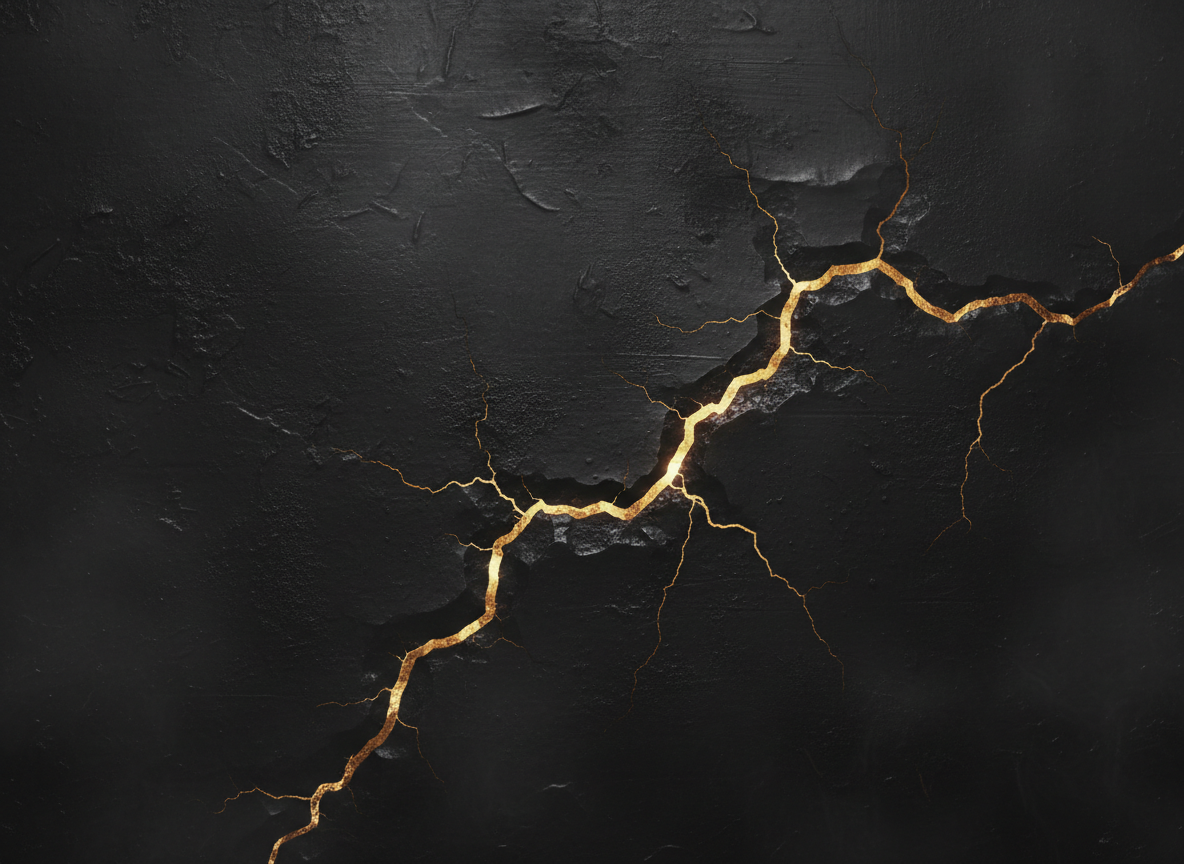
The cellar did not lead downward. It led inward.
Marek expected steps, stone, cold earth beneath his hands. What he found instead was a corridor lined with a darkness so complete it made the world behind him feel like memory. The blade the old man had given him was a thin line of dull metal — barely a weapon — but in that corridor it held the faintest suggestion of outline, like the edge of an unfinished thought.
He walked because stillness meant death. Not physical death — he had stopped fearing that years ago — but the other kind, the kind that eats identity one crumb at a time. The kind he had already tasted on the street when nights piled up like forgotten graves.
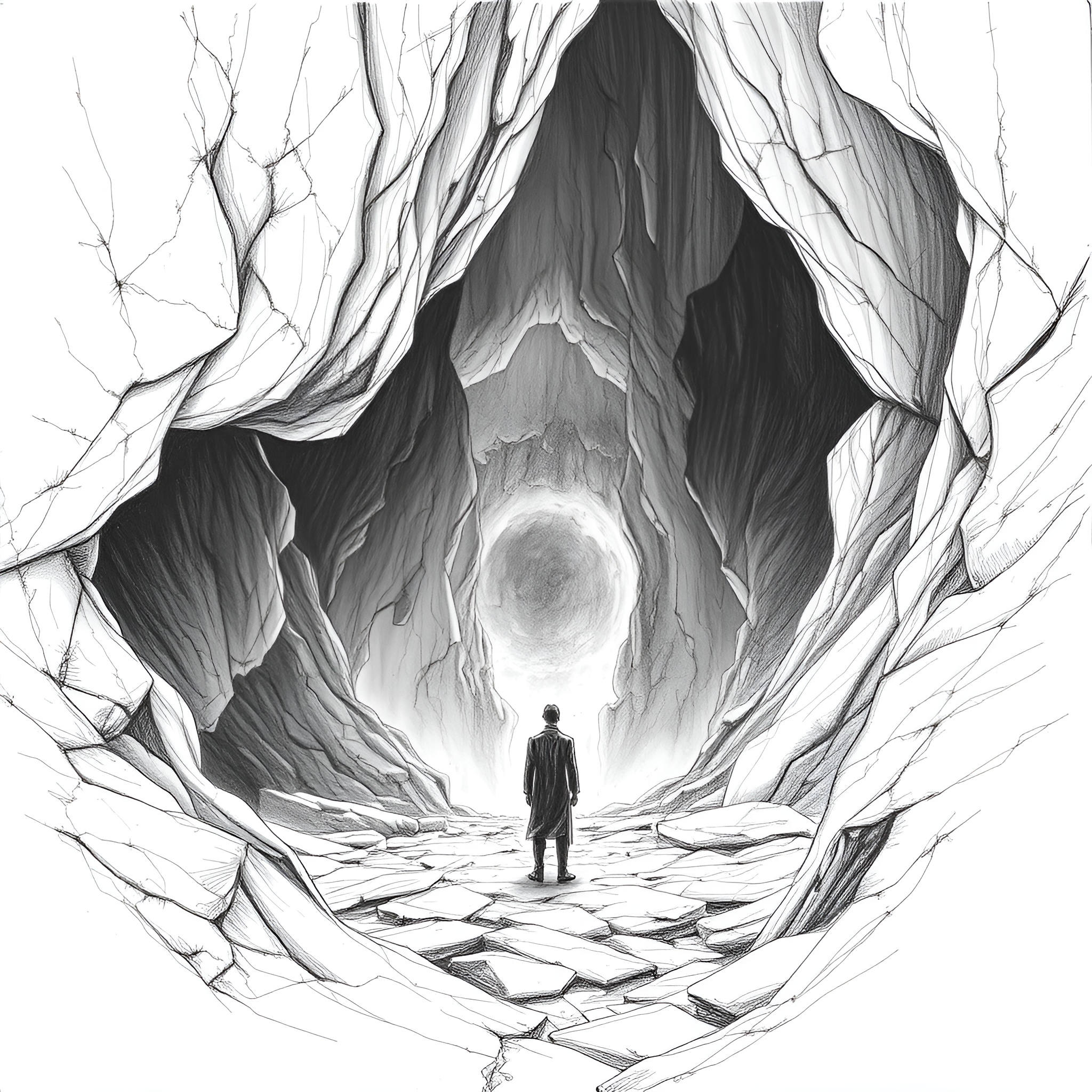
The corridor tightened. His shoulders brushed unseen walls. Then the walls began to breathe. A slow, rhythmic expansion and contraction, like lungs made of stone. He didn’t know if it was the structure or his mind. In the Nothing, the distinction is meaningless.
After what felt like hours, the corridor opened into a vast chamber.
The chamber wasn’t empty.
It was *waiting.*
Silence lives in two forms: the kind you choose, and the kind that chooses you. This chamber held the second kind. It swallowed the scrape of his boots. It dampened his breath. It took his heartbeat and returned nothing. Every sound he made died before it reached his ears.
He tried speaking.
“Hello—”
The “lo” never arrived. The echo that should have followed fell straight to the floor like a stone. He felt it land near his ankle, dead and cold.
He tried again, louder.
Nothing.
Not even the sound of his own throat moving.
Marek realized the chamber wasn’t muting sound — it was *feeding* on it. The silence here wasn’t an absence; it was a predator.
The walls glimmered faintly. Not with light, but with memory. As he walked deeper, shadows formed along the edges — not figures, not ghosts — but moments. Flickers of life he had once lived: a woman turning away, a bottle tipping, a lie he told at nineteen that cost him a friend, the hollow-eyed face he saw in the reflection of a bus window the night he slept behind a grocery store.
The chamber was showing him the only companion silence always offers: the self you can no longer avoid.
He tried to steady his breath, but even breath became an accusation. In the real world, noise distracts, blurs, calms. Here, the quiet carved him open. With each step he felt the weight of things he had buried. The chamber did not torture him with screams. It tortured him with everything he had refused to hear.
*You are alone.*
*You always were.*
*You kept moving to avoid seeing what you were becoming.*
*Now look.*
He pressed his palm against the nearest wall. It felt alive, pulsing like a throat. When he pulled his hand back, a mark was left where he had touched — a faint glow outlining the shape. The wall absorbed it slowly, as if the silence had tasted him and wanted more.
He spoke again — or thought he did. It was impossible to know. The silence swallowed whatever left his lips. But something inside the chamber replied, not in sound, but in sensation: a tightening of the air, a pressure against his spine, a presence shifting behind him.
He spun, blade raised.
Nothing.
The presence moved again, closer this time.
He backed toward the wall. Something brushed his shoulder, but when he turned, there was no shape, no form — only the thick, awful impression that the silence itself was circling him, curious, patient.
The chamber was not here to kill him.
It was here to *strip him.*
He tried to run. His legs carried him three steps before a tremor crawled up from the floorboards and took his breath away. Not a quake — a warning.
He stopped.
The silence settled.
Marek understood:
You cannot run from what you brought with you.
So he stood in the center of the chamber and did the one thing he had avoided his entire life.
He faced himself.
He closed his eyes. He let the cold quiet flood him. He let the memories come. The betrayals. The failures. The lies. The shame. The cowardice. The hunger. The years he could not recall because the bottle stole them. And the deeper truth beneath all the pain:
He had never been alone — he had just never listened.
He breathed.
For the first time in years, the breath belonged to him.
The silence shifted again, but this time it felt different — less predator, more witness. The pressure in the room eased. The walls softened. The darkness lifted by a single shade. The chamber was not congratulating him. It was acknowledging that he had stopped running long enough for the truth to land.
He felt something press lightly against his wrist.
He looked down.
The blade in his hand — the dull strip of metal — had changed. Not glowing, not enchanted, nothing childish like that. The metal had sharpened. The edge now looked precise enough to split a hair.
The chamber had refined it the same way it had refined him.
The silence released him.
A thin seam opened in the far wall — just wide enough for a man to pass through. Beyond it, he heard something that did not belong in silence.
Breathing.
A slow inhale.
A slower exhale.
Something alive waited behind that seam.
Something vast.
Something that had been listening.
He stepped toward it.
As he crossed the threshold, the chamber whispered the first truth he would carry for the rest of his life — not in words, but in the steady, steady acceptance that filled his bones:
**To walk the Nothing, you must first learn to walk alone.**
“Aloneness isn’t a punishment.
It’s a furnace.
It burns off the parts of you that were held together by noise, people, lies, and routine.
When the world takes everything, it leaves you the rawest companion you’ll ever know.
Yourself.
If you can stand in that silence without running, you begin.”
As Marek stepped through the seam, the air changed.
Colder.
Thinner.
The breathing he’d heard grew louder, deeper — like the lungs of something older than the chamber, older than pain, older than any god men pretend to believe in.
Then it stopped.
And from the dark ahead came a voice that wasn’t a voice at all, but a pressure against the center of his mind:
“Walk further, Marek.
Only in the void do you learn what you truly are.”
He raised his sharpened blade.
The darkness moved.
And he entered the Void.
From This Post
The cellar did not lead downward. It led inward. Marek expected steps, stone, cold earth beneath his hands. What he found instead was a corridor lined with a darkness so complete it made the world behind him feel like memory. The blade the old man had given him was a thin line of dull metal…
24 hard lines, art, betterment, code, consciousness, dark, dark fantasy, decision-making, deep, depression, Design, fear, future, hard men, health, help, industrial-noir, inner strength, internet, learning, legend, life, lost, masculinity, mastery, mental-health, metaphor, mind, neuroscience, philosophy, principle, psychological, psychology, real life, reality, rebuilding, self reliance, self-development, severe • grounded • grimly hopeful • unbreakable • precise • poetic human, spirituality, stoicism, struggle, theory
Discover more from 24 Hard Lines
Subscribe to get the latest posts sent to your email.
Go Deeper
“This is just the surface.
Are you someone who digs deeper?”
24 Hard Lines
More from 24 Hard Lines