Saga of the Third Lesson
The stone beneath Marek’s feet was the first true thing he’d felt in a long time.
Too true.
It reminded him of the world he came from — the one where choices had weight and consequences had teeth.
The teeth appeared first.
Dozens of them, pale and sharp, glinting at the edge of the dim light ahead.
No bodies yet — just the promise of violence.
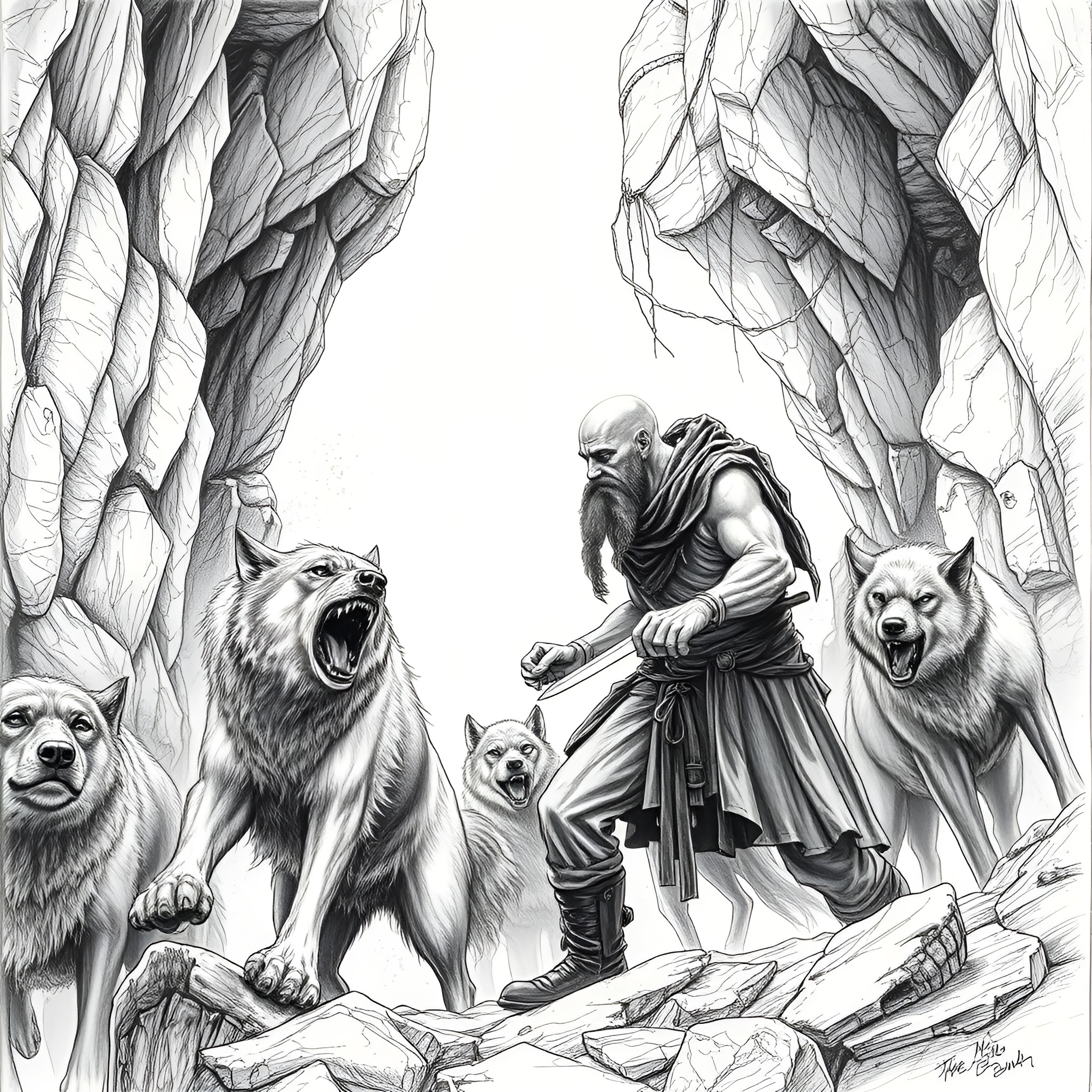
The wolves circled.
Not real wolves.
Real wolves kill for hunger, out of instinct and need.
These things — these shadows with jaws — killed out of memory.
They smelled the old versions of him, the parts he thought he left behind.
He recognized them instantly.
Every man knows the shape of his own ruin.
The first wolf stepped forward. Its eyes weren’t eyes — they were small, reflective circles like bottle caps glinting in the dark. The stench of cheap liquor and bad decisions rolled off it.
Marek swallowed.
He had fed this one for years.
The wolf opened its jaws, and the sound that came out wasn’t a growl — it was laughter. His laughter. The kind he used to cover guilt. The kind that meant he was drunk enough to pretend he didn’t care.
It lunged.
Marek dodged, the blade slicing the air. The wolf dissolved into mist and reformed behind him, snarling.
Then the second wolf crawled into the light — its fur matted with old excuses, its ribs showing the gaps in his life where discipline should’ve been. Where promises were broken. Where potential rotted.
It spoke in a voice that wasn’t a voice at all, but a memory:
“You said you’d quit.
You said it every night.”
More wolves emerged.
A wolf with the limp of every missed opportunity.
A wolf stitched together from lies he told to make himself look better.
A wolf born the night he betrayed himself “just this once.”
A wolf made from the version of him that kept letting the days die without fight.
He tightened his grip on the blade.
The wolves drew closer.
He realized something:
They weren’t attacking yet.
They were testing him.
Waiting to see if he’d run.
Because that’s how habits survive:
By convincing you there’s always tomorrow to deal with them.
Marek exhaled slowly.
The wolves froze.
One tilted its head, curious.
He stepped forward.
That broke the stalemate.
The pack surged.
The first wolf — the bottle-eyed one — leapt with a wild, ugly joy. Marek caught it midair, blade under its jaw, slicing upward. It didn’t bleed. It released a cloud of black smoke — the smell of last chances burned away.
The wolf dissolved.
Another took its place.
Habit is never one beast.
It is a breeding ground.
Marek fought in tight arcs, each swing of the blade slicing through a memory, a pattern, a reflex that once defined him.
But the wolves learned.
Every time he killed one, the others adjusted their angle, corrected their rush, refined their hunt.
It hit him:
This was the first battle in his life where the enemy improved as he did.
He swung wide at a grey wolf with scars where restraint should’ve been. It darted under the blade and snapped its jaws around his forearm— except there was no pain.
There was hunger.
A craving.
A longing.
A chemical whisper in his blood.
He ripped his arm free.
The wolf smiled.
These wolves didn’t want flesh.
They wanted permission.
He stumbled back and the pack advanced, slowly, confidently, the way predators behave when they recognize old prey.
He felt the pull — that familiar, terrible gravity — the temptation to surrender, just for a moment, to let them take him. It would be easier. So much easier. Let the wolves drag him back to the old life, the old story, the old Marek.
He almost stepped backward.
Almost.
Then something shifted inside him — a memory, sharp and cold:
If the Void had stripped away what was false, these wolves were everything false that had survived the stripping.
He planted his feet.
Raised the blade.
And spoke into the darkness — not to the wolves but to himself:
“Not again.”
The ground trembled.
The wolves hesitated.
The blade lit with the faintest shimmer — not magic, but conviction. A tool sharpened by the Cave, hardened by the Void, now fueled by refusal.
He attacked first.
The pack broke.
He cut through the liar-wolf, the coward-wolf, the escape-wolf, the one-quick-fix wolf, the wolf of warm poison nights.
Each dissolved into smoke that smelled like burning bridges and broken time.
He didn’t kill them all.
He didn’t have to.
When he’d pushed them back far enough that they couldn’t close the circle again, Marek lowered the blade.
The wolves stopped moving.
They stared at him from just beyond the edge of the light, dozens of yellow eyes flickering like funeral candles.
Not dead.
Not defeated.
But contained.
For now.
The path ahead brightened, revealing worn stones leading upward, toward something ancient and heavy.
The wolves watched him leave.
Because habits don’t vanish.
They wait.
Marek walked forward anyway.
“Habits don’t die.
They retreat.
They circle.
They wait for weakness.
You don’t conquer them once — you meet them every day.
But the day you stop running
is the day their teeth get dull.”
The path narrowed into a tight stair carved into the mountainside.
Every step upward felt heavier, as if invisible hands were weighing his thoughts.
At the top of the staircase stood a doorway made of bone-white stone.
Words carved across its lintel glowed faintly:
“Knowledge owed.
Knowledge paid.”
Marek stepped closer.
A cold wind pushed him through the archway before he could hesitate.
A single lantern ignited.
And a figure turned toward him…
Holding a ledger with Marek’s name already written inside.